The problem
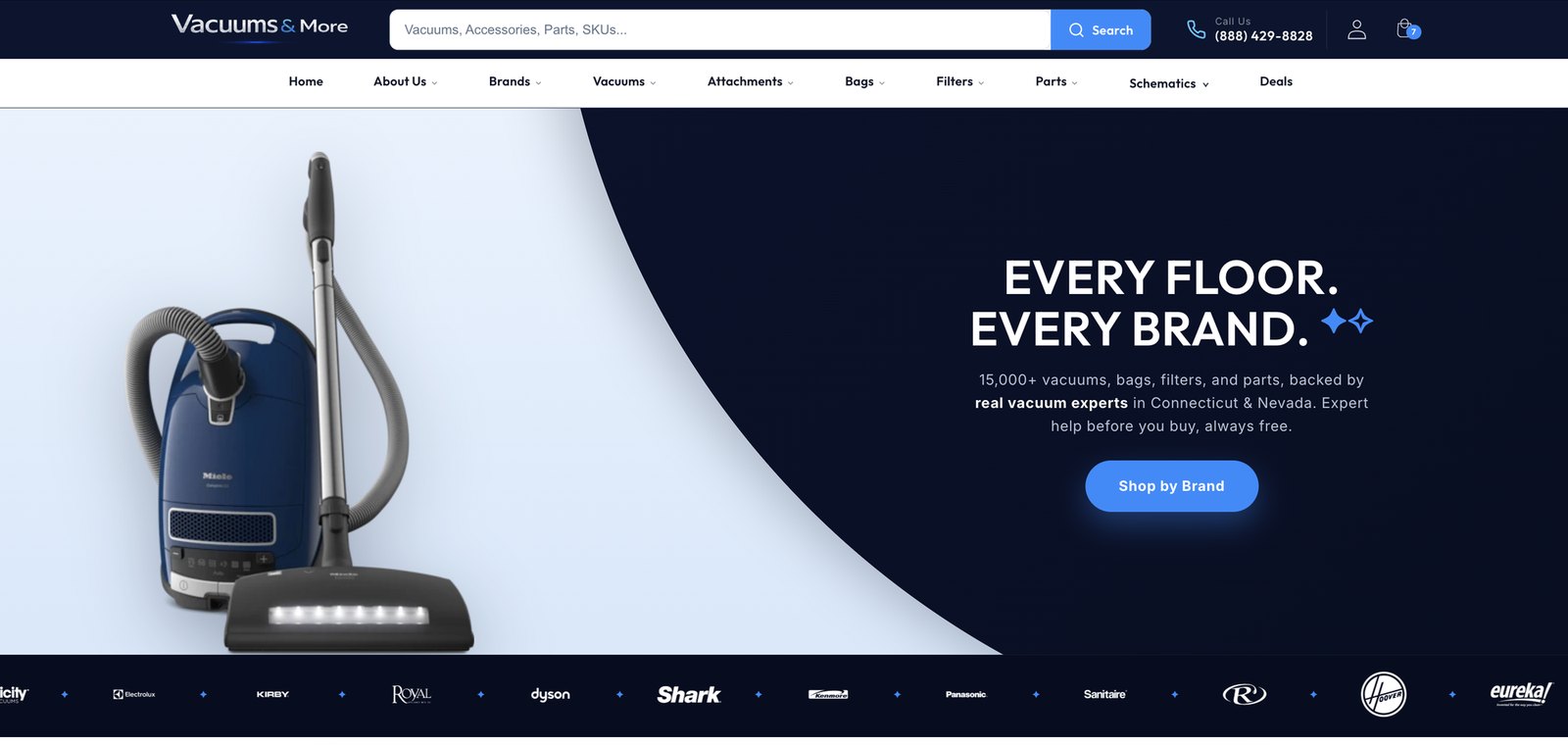
When I started, Vacuums and More had no online presence at all. Three stores, a deep parts catalog, and no one whose job was to put it on the internet.
What I built
A pricing engine that reprices the whole catalog every 12 hours, with a 20% margin floor and minimum advertised price (MAP) locks that nothing can override. When an audit found 512 products had drifted below the floor, I added a clamp that blocks any below-floor price before it is written. A health check refuses to price at all when its inputs are more than 14 days old or incomplete.
Pipelines for six vendor catalogs, each behind a dealer login and each with its own quirk: data buried as JSON in pages, cost shown only in the cart, part numbers that didn't match ours. One vendor's 1,602 products went live with zero duplicates, checked against the live store.
Content at scale: waves of writer agents and adversarial reviewer agents behind a pass or fail gate rewrote 3,100 product descriptions in 8 waves, with zero regressions on the live store.
How the content agents worked
Each wave took up to 400 products. Nineteen writer agents drafted in parallel, then an automated scan flagged every draft that broke a rule, and the writers fixed their own failures until the scan passed. A second lane of reviewer agents read every draft adversarially, hunting for anything a customer could be misled by, and a third checked specs against the web with citations. Claims nobody could source came out.
In the first wave the reviewers caught 96 defects, six of them made-up product claims, before anything reached the store. Nothing went live with an unfixed defect, and every wave was checked against the live store afterwards. Later waves needed fewer fix rounds because each wave's lessons went back into the writers' instructions.
A technical SEO rebuild that raised the site's audit score from 1.91 to 3.42 out of 5. Along the way it removed 7,436 watermarked images, cut 558 duplicate products to zero, and got a Google Merchant Center suspension lifted, after which clicks rose 61.5% over the next 28 days.
The result
A store that had no online presence now does about $30,000 a month online, and about 94% of the orders we can trace come from Google search, with no ad spend.